Service · Des Moines, IA
New Construction Radon-Resistant Systems in Des Moines, IA
A passive radon-resistant system installed before the slab pour on new construction, far easier and less expensive than adding one after the home is finished.
Send us your details and we get back to you fast with a written quote.
We do not make you wait weeks for a test or an install date.
One shop, one service area, no franchise call center.
Building on Iowa's glacial till soil in EPA Radon Zone 1 means new construction in the Des Moines metro is a good opportunity to plan for radon from the start rather than test and retrofit later. A passive system installed before the slab pour costs a fraction of what the same system costs to add after the house is built.
We work directly with builders and homeowners during the framing and pre-pour stage to get the piping and sub-slab prep in place while the foundation is still open.
Why new construction is the easy time to do this
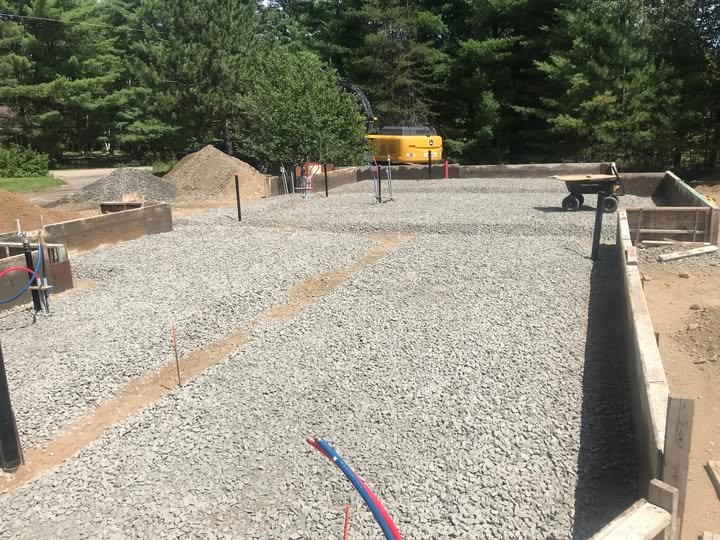
Once a slab is poured, a retrofit means drilling into finished concrete and running pipe through a completed house. Before the pour, the same system is a layer of gravel, a perforated pipe and a vertical stub run up through the framing before drywall goes in, dramatically less invasive and less expensive.
What a passive system includes
A layer of clean, coarse gravel under the slab lets soil gas move freely to a collection point. A perforated pipe in that gravel connects to solid pipe that runs up through the house to above the roofline. The slab itself gets sealed carefully around any penetrations. This passive setup relies on natural pressure differences to vent gas, and it can be upgraded to an active system with a fan later if a post-construction test shows it needs the extra pull.
Passive now, active later if needed
Not every home needs the fan running from day one. Building the passive system in during construction means that if a test after move-in shows an elevated level, adding a fan to an already-installed pipe is a small job instead of a full retrofit.
Working with your builder
We coordinate directly with the framing and foundation crews so the radon system does not hold up the build schedule. Most of this work happens in a single visit timed around the sub-slab prep and rough framing stages.
New Construction Radon-Resistant System Installation across Polk County
We run this work throughout Des Moines and the surrounding towns. In places like Des Moines, West Des Moines and Ankeny, no two elevations are exactly the same, so every job gets scoped on site rather than over the phone.
- New Construction Radon-Resistant System Installation in Des Moines
- New Construction Radon-Resistant System Installation in West Des Moines
- New Construction Radon-Resistant System Installation in Ankeny
- New Construction Radon-Resistant System Installation in Urbandale
- New Construction Radon-Resistant System Installation in Johnston
- New Construction Radon-Resistant System Installation in Clive
- New Construction Radon-Resistant System Installation in Waukee
- New Construction Radon-Resistant System Installation in Altoona
- New Construction Radon-Resistant System Installation in Pleasant Hill
- New Construction Radon-Resistant System Installation in Windsor Heights
- New Construction Radon-Resistant System Installation in Norwalk
- New Construction Radon-Resistant System Installation in Indianola
- New Construction Radon-Resistant System Installation in Carlisle
Common questions
New Construction Radon-Resistant System Installation questions we hear in Des Moines
Requirements vary by jurisdiction and builder. Regardless of what is required, given that IA is EPA Radon Zone 1, we recommend it as a low-cost addition during the build rather than waiting to test after move-in.
A passive system installed during construction costs meaningfully less than the same system retrofitted after the slab is poured, since there is no drilling into finished concrete or routing pipe through a completed house.
Yes. A passive system reduces radon entry, but testing after move-in tells you whether the passive setup is enough on its own or whether it needs a fan added to become an active system.
What neighbors say
Referral work is most of our schedule
PLACEHOLDER review. Two to four sentences in a real customer voice, naming the job and the city.
PLACEHOLDER Name — Des Moines
PLACEHOLDER review. Mention a specific detail — the crack repair matched, the crew cleaned up, the estimate held.
PLACEHOLDER Name — Des Moines
PLACEHOLDER review. Something about responsiveness or the written scope works well here.
PLACEHOLDER Name — Des Moines
Get a straight answer on your wall
Free on-site estimates across Des Moines and Polk County. We look at the actual wall, measure the elevations and send a written scope — no charge and no sales pitch.